
Your website is slow. Or it keeps going down at random. Or you’re getting close to your storage limit. Or your developer just told you “you need a VPS” — and you nodded, said you’d look into it, and then Googled it and felt more confused than before.
This is one of the most common conversations we have with clients at Alphatech. Not because it’s complicated — it genuinely isn’t — but because most hosting explainers are written by people trying to sell you the more expensive option.
We’re going to break this down the way we’d explain it to a business owner sitting across from us: what each option actually is, what it costs in Kenya today, when you should upgrade, and when you’re being oversold.
Shared Hosting vs VPS: Quick Comparison
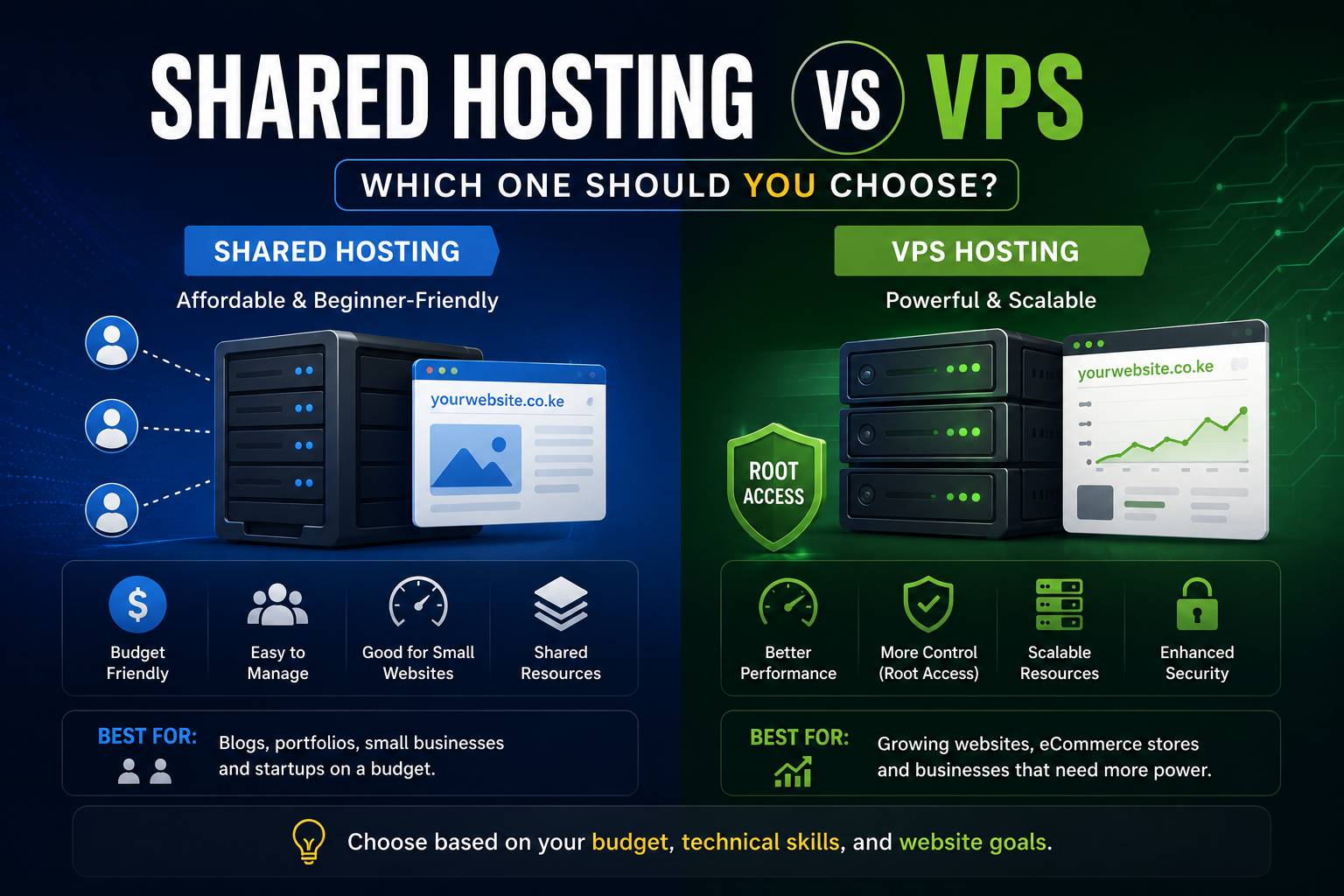
Before we get into the details, here is how the two options stack up for Kenyan businesses in 2026.
| Factor | Shared Hosting | VPS | Best for |
|---|---|---|---|
| Cost (Kenya) | KES 800–4,000/month | KES 2,500–9,000+/month | Budget-conscious SMEs vs revenue-generating platforms |
| Performance | Variable — depends on neighbours on the same server | Guaranteed CPU, RAM, and storage allocated to you | Low-traffic brochure sites vs high-traffic or optimised apps |
| Control | Limited — pre-configured LAMP stack only | Full root access — install custom software | Managed simplicity vs custom integrations (M-Pesa callbacks, Redis, Node.js) |
| Best for | Brochure sites, blogs, small WooCommerce stores | E-commerce at scale, portals, APIs, background workers | Start here; upgrade when revenue or technical needs demand it |
| Kenya providers | Truehost, WhoGoHost Kenya, KenyaWebExperts, Namecheap, Hostinger | Truehost VPS, DigitalOcean, Linode/Akamai, Contabo, AWS Nairobi | Local support vs global pricing — weigh latency for Kenyan visitors |
What shared hosting actually means
Imagine a large apartment building. Dozens of families live in the same building, share the same water supply, the same electricity infrastructure, the same compound. It’s affordable because costs are split. But if one family decides to run a restaurant out of their unit and starts using ten times the electricity, everyone’s lights flicker.
Shared hosting works the same way. Your website lives on a physical server alongside potentially hundreds of other websites. You share the same CPU, the same RAM, the same bandwidth pipe. When everything is quiet, performance is fine. When a neighbour’s website gets a traffic spike, yours slows down. You have no control over who your neighbours are or what they’re doing.
This is not a flaw — it’s the design. Shared hosting is built for affordability, not isolation.

What a VPS actually means
VPS stands for Virtual Private Server. The “virtual” part is key. It’s still a physical machine somewhere in a data centre, but that machine is divided into separate isolated environments using software. Your slice of that server has its own allocated RAM, its own CPU cores, its own storage — guaranteed to you, regardless of what other websites on the same physical machine are doing.
Think of it less like an apartment and more like a gated townhouse. You’re still in a complex, technically sharing some infrastructure — but your unit is fully contained, your resources are yours, and your neighbour’s bad weekend has no effect on your Tuesday morning.

The real cost comparison in Kenya (2026)
Let’s talk actual numbers, because most articles cite USD prices that don’t reflect the Kenyan market reality.
Shared hosting in Kenya currently runs between KES 800 and KES 4,000 per month depending on the provider and plan tier. The popular local providers — Truehost, WhoGoHost Kenya, KenyaWebExperts — offer entry packages in the KES 800–1,500 range. International providers like Namecheap or Hostinger, which many Kenyan developers use, price in USD but often work out to KES 1,500–3,500 per month when you factor in exchange rates and annual billing.
VPS hosting starts at around KES 2,500–4,000 per month for an entry-level instance (1 vCPU, 1–2GB RAM) and scales up from there. A decent production VPS for a medium-traffic Kenyan business — 2 vCPU, 4GB RAM, 80GB SSD — typically runs KES 5,000–9,000 per month. DigitalOcean, Linode (now Akamai), and Contabo are popular choices among Kenyan developers for VPS. Contabo in particular offers aggressive pricing — their entry VPS (4 vCPU, 4GB RAM) runs around $5–6/month, which at current rates is under KES 800. The tradeoff is that their support is slower and their data centres are in Europe or the US, which can add latency for Kenyan visitors.
For that reason, if your audience is primarily in Kenya or East Africa, it’s worth paying a bit more for a VPS hosted closer — either an AWS Nairobi region instance, or a provider with a Johannesburg point of presence, which is the closest major data centre to Nairobi.
What shared hosting is genuinely good at
Shared hosting has a bad reputation it doesn’t entirely deserve. For the right use cases, it is exactly what you need — and paying for a VPS when you don’t need one is just money you don’t have to spend.
A shared hosting plan is the right choice when you’re running a standard business website — five to fifteen pages, a contact form, maybe a blog — with typical Kenyan SME traffic levels. If your site gets a few hundred to a few thousand visitors per month and you’re not running a database-heavy application, a mid-tier shared hosting plan handles this comfortably.
Schools with basic WordPress sites, NGOs with informational websites, freelancers with portfolio sites, restaurants with menu pages and a reservation form — all of these are well-served by shared hosting. The cost savings are real and the performance difference, for these workloads, is negligible.
Shared hosting is also appropriate when your developer is managing the technical infrastructure. If you’re on a plan with a managed provider who handles backups, security patching, and uptime monitoring, the reduced responsibility has genuine value.
What shared hosting handles well: standard WordPress sites, WooCommerce stores with moderate traffic, small business websites, landing pages, and portfolio sites.
What it struggles with: high concurrent traffic, resource-intensive applications, custom server software requirements, and anything that requires root access to configure properly.
What VPS hosting genuinely changes
When we migrated a Nairobi-based educational platform from shared hosting to a VPS, page load time dropped from 7.2 seconds to 1.4 seconds. Same code. Same database. Just dedicated resources instead of competing for time on a crowded server.

That’s the most visible change: performance. But it’s not the only one.
On a VPS, you have root access to the server. That means you can install custom software — not just PHP and MySQL that your host pre-configures, but Node.js, Redis, custom queue workers, Python scripts, Nginx configurations, SSL setups tailored to your exact requirements. For a business running an M-Pesa callback listener, a background PDF generator, a real-time notification system, or any kind of background processing — shared hosting simply can’t support that. The software isn’t allowed, and the resources aren’t guaranteed.
VPS hosting is also where horizontal scaling becomes possible. Start with a single VPS. As traffic grows, you can upgrade your instance size, add a load balancer, or spin up a second server for the database. Shared hosting has a ceiling — you can upgrade to a higher-tier shared plan, but eventually you hit the structural limitation of the environment itself.
Security posture also improves. On shared hosting, you’re only as secure as your least-careful neighbour. A vulnerability in another website on your server can sometimes be used to access adjacent sites’ files, depending on how the host has configured isolation. On a VPS, you own the environment — you control the firewall rules, you control what’s installed, you control who has access.
The five signs you’ve outgrown shared hosting
This is the question we get most often: “How do I know it’s time?” Here are the signals that consistently precede a necessary migration.
1. Your site loads slowly despite being well-optimised. You’ve compressed images, enabled caching, minified assets — and your GTmetrix score still shows a slow time to first byte. Slow TTFB on a well-optimised site is almost always a server resource issue, not a code issue. That’s a shared hosting bottleneck.
2. You’re getting 500 or 503 errors during traffic spikes. This happens when your application exceeds its allocated memory or CPU time on a shared server. The host throttles or kills the process. You see an error. Your customer sees a broken page and leaves.
3. Your developer needs to install custom software. The moment a project requires something beyond the standard LAMP stack — a Node.js service, a Python worker, Redis for caching, a custom Nginx configuration — you need root access. Shared hosting doesn’t provide that.
4. You’re processing financial transactions at scale. We take the position that any platform handling significant M-Pesa volumes, managing user accounts with payment data, or running a marketplace should be on a VPS minimum. The additional control over security configuration is worth the monthly cost difference.
5. You’re running multiple applications. A growing agency or technology company often runs several distinct services — a main website, an admin dashboard, an API, a staging environment. Running all of these on a single shared hosting account is technically possible and practically fragile. A VPS gives you the environment to run them cleanly and independently.
The decision tool: 3 questions to choose Shared vs VPS
Answer these three questions honestly about your current situation. Each outcome points to a clear recommendation with realistic Kenya budget figures.
Question 1: Is your website earning revenue or processing payments?
If yes — you accept M-Pesa, run an online store, sell subscriptions, or your site directly generates leads that convert to sales — lean toward VPS. Budget KES 5,000–9,000/month for a production instance. Uptime and performance directly affect revenue; shared hosting risk is not worth the savings.
If no — your site is informational, a portfolio, or a brochure with a contact form — shared hosting is fine. Budget KES 1,000–2,500/month on Truehost or Namecheap shared.
Question 2: Does your developer need to install anything beyond standard WordPress/PHP?
If yes — Node.js, Redis, custom queue workers, M-Pesa callback listeners, Python scripts, or custom Nginx configs — you need VPS with root access. Shared hosting will block or throttle these. Entry VPS from KES 2,500/month; plan KES 5,000+ for production workloads.
If no — standard WordPress, WooCommerce with a plugin, contact forms — stay on shared hosting until traffic or errors prove otherwise.
Question 3: Are you seeing performance problems or errors under normal traffic?
If yes — slow TTFB despite optimisation, 500/503 errors during regular business hours, or storage limits hit monthly — upgrade to VPS now. Don’t wait for a catastrophic failure. Migration costs less when planned than when emergency.
If no — site loads acceptably on mobile data, forms work, no random downtime — shared hosting still fits. Revisit this question every 6 months or when traffic doubles.
| Your answers | Recommendation | Monthly budget (Kenya) |
|---|---|---|
| Mostly “no” to all three | Shared hosting | KES 1,000–2,500 |
| 1 “yes” (revenue OR custom software) | VPS (entry) | KES 2,500–5,000 |
| 2+ “yes” OR payment platform at scale | VPS (production) | KES 5,000–9,000 |
| Errors/downtime already happening | Migrate to VPS immediately | Plan migration this week — not next quarter |
Not sure how to read your answers? Contact us with your current hosting setup and traffic levels — we’ll tell you honestly whether you need to move.
The hidden cost of upgrading too late
There’s a cost to staying on shared hosting past the point where you should have moved, and it’s one most business owners don’t factor in: lost revenue from a slow or unavailable website.

A Kenyan e-commerce business that processes M-Pesa transactions on a shared hosting plan and goes down for two hours during a flash sale doesn’t just lose those two hours of sales. They lose the customers who attempted the transaction, got an error, and went somewhere else. They lose the trust of customers who’ll think twice before attempting again. They may lose their Google ranking if the downtime is detected by crawlers during a critical indexing window.
Shared hosting is genuinely the right starting point for most Kenyan businesses. But the moment your website starts earning revenue for your business — not just representing it — the calculation changes. A KES 4,000/month VPS that keeps your transaction system running reliably is not a cost. It’s infrastructure.
We’ve had clients push back on VPS costs by pointing out that their shared hosting was “working fine.” It was — right until the day it wasn’t. An ISP client in Western Kenya ran a billing portal on shared hosting for two years without incident, then had a catastrophic failure during month-end billing when dozens of customers tried to pay simultaneously. The shared server couldn’t handle the concurrent requests. Payments failed. Customers called angrily. The migration to VPS happened the next morning and cost more in emergency setup fees than six months of VPS hosting would have.
Plan the move before you’re forced into it.
The right way to migrate from shared to VPS
When you’re ready to move, the migration does not have to be stressful or risky. Here is the approach we use at Alphatech.

Step 1: Set up and configure the VPS first, completely, before touching anything on the old server. Install the web server, PHP, MySQL or MariaDB, your control panel if you’re using one (we often use Hestia CP for its clean interface), and SSL via Let’s Encrypt. Test the server responds correctly on the IP address before migrating any files.
Step 2: Clone the site to the new server. Export the database from the old host, import it on the VPS. Copy all website files via SFTP. Verify that the site works correctly on the new server by testing via the IP address or a temporary subdomain — without changing DNS yet.
Step 3: Lower your domain’s DNS TTL to 300 seconds (5 minutes) at least 24 hours before the migration window. This means when you change the DNS records, propagation happens faster and the window where some visitors are hitting the old server while others hit the new one is much shorter.
Step 4: Change the DNS A record to point to the new VPS IP. Wait for propagation — tools like whatsmydns.net let you see propagation status from different global locations. Keep the old hosting account active for at least 48 hours after the migration, in case any visitors are still resolving to the old IP.
Done properly, the entire migration window where any visitor sees anything other than a working website is measured in minutes, not hours.
Our recommendation for Kenyan businesses in 2026
Start on shared hosting. A plan on Truehost Kenya or Namecheap shared at KES 1,000–2,500/month is the correct starting point for a business website, a school portal, an NGO site, or a small WooCommerce store. The cost is right, the performance is adequate, and you’re not paying for resources you’re not using.

Move to VPS when any of the following is true: you’re processing meaningful M-Pesa transaction volumes, your developer needs custom server software, your site is loading slowly despite being well-optimised, or you’re getting intermittent errors under normal traffic. At that point the cost difference — roughly KES 3,000–5,000/month more — is justified by what you get in return.
If you’re not sure where you are in that spectrum, reach out. We’ve migrated dozens of Kenyan websites between hosting environments and we’re happy to look at your current setup and tell you honestly whether you need to move.
Ready to talk about your hosting?
Whether you’re just starting out and want to get it right from day one, or you’re experiencing performance problems and need a proper migration, we can help. Visit alphatechdevelopers.co.ke or send us a message to book a free consultation.