
Every week we get on a call with a Kenyan business owner who’s been burned. They paid a developer KES 15,000 for a “website” built on a Shopify trial that expired, or they’re locked inside a WordPress theme they can’t modify, or they hired someone to build a custom platform that was abandoned halfway through and can’t be maintained by anyone else.
The wrong platform choice doesn’t just cost you money upfront. It costs you months of rebuilding and leads you never captured. This article exists to save you from that.
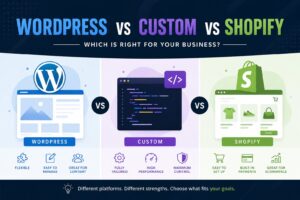
We’re going to be direct with you – the way we’d talk to a client sitting across the table from us in Embu – about what each platform actually means for your business, your budget, and your growth.
Platform comparison at a glance
Use this table as a quick reference before diving into the details below. Every Kenyan business is different, but these patterns hold true across most of the projects we see.
| Factor | WordPress | Shopify | Custom |
|---|---|---|---|
| Cost | Mid upfront (KES 30k-150k build); low ongoing hosting (~KES 3k-5k/mo) | Low upfront; high ongoing ($29+/mo + transaction fees + apps) | High upfront (KES 80k-500k+); lowest ongoing (VPS ~KES 3k/mo) |
| M-Pesa | Strong – mature plugin ecosystem, native Daraja STK Push | Weak – checkout controlled by Shopify; STK Push needs workarounds | Excellent – built exactly how your customers expect to pay |
| Flexibility | High for marketing sites and WooCommerce; limits at complex logic | Moderate – fast for standard e-commerce; hard to customise deeply | Unlimited – designed around your exact business workflow |
| Maintenance | You + hosting; any Kenyan developer can maintain it | Shopify handles infrastructure; you manage apps and content | You own everything; needs documented handover and skilled devs |
| Best for | SMEs, schools, NGOs, tour operators, SACCOs, straightforward e-commerce | International card sales, drop-shipping, fast validation launches | Marketplaces, SaaS, billing systems, LMS, unique workflows |

First, understand what you’re actually choosing between
These are not just three website builders. They represent three completely different philosophies:
WordPress is an open-source CMS that you install on your own hosting. You own everything – the files, the database, the domain. You can modify anything. The tradeoff is that “owning everything” also means maintaining everything.
Shopify is a hosted e-commerce platform. You pay a monthly subscription and Shopify handles the servers, security, and updates. You don’t own the infrastructure – you’re renting it. The tradeoff is that it’s faster to launch but slower to customise or scale beyond Shopify’s boundaries.
Custom development means building from scratch in a language like PHP, React, Node.js, or Python – no CMS installed by default, no third-party platform fees. You get exactly what you need and nothing you don’t. The tradeoff is higher upfront cost and a longer build time.
WordPress: the right default for most Kenyan businesses
WordPress powers over 40% of all websites globally – and there’s a very practical reason for that. It’s the best balance of cost, flexibility, and maintainability for small-to-medium businesses that don’t have a dedicated technical team.
At Alphatech, the majority of our client projects are WordPress builds. A secondary school in Central Kenya needed a student portal with fee collection via M-Pesa. A tour operator in Nairobi needed a booking system with itinerary management. A logistics company in Mombasa needed a cargo tracking dashboard. All of these ran on WordPress with custom plugins, and all of them were delivered in under six weeks.
Where WordPress wins in Kenya:
WordPress has a mature M-Pesa plugin ecosystem – tools like WPPayForm and custom Daraja integrations slot in cleanly. Hosting is affordable in Kenya; you can run a solid WordPress site on a 5GB shared hosting plan from Truehost or even a budget cPanel provider in Nairobi for under KES 5,000 per month. When something breaks (and it will, eventually), any developer in the country can open your WordPress admin, look at the files, and fix it. That maintainability is worth more than people realise.
Where WordPress struggles:
WordPress was built as a blogging platform and retrofitted for everything else. The result is that complex business logic – multi-tier commission systems, real-time inventory syncing, automated billing – can be done in WordPress, but it starts to feel like forcing a square peg into a round hole at a certain level of complexity. Performance also needs active management: unoptimised WordPress sites load slowly, especially on Kenyan internet speeds, and a slow site loses customers.
Who should choose WordPress:
- Businesses needing a marketing website with a blog
- Schools needing a portal + fee payment system
- NGOs needing donation pages and content management
- Tour operators needing booking integrations
- SACCOs needing member portals with M-Pesa
- Businesses needing WooCommerce for straightforward e-commerce

Shopify: fast to launch, expensive to own long-term
We’ll be honest about Shopify: it is a genuinely excellent platform – for certain businesses, in certain contexts. The problem is that many Kenyan businesses are sold Shopify by developers who find it easier to set up quickly, without being told about the long-term costs and limitations.
Shopify’s biggest selling point is that it removes infrastructure worry entirely. You don’t manage servers, handle SSL renewals, worry about backups, or think about scaling. For a global e-commerce brand with a large team, that’s valuable. For a small Kenyan business with a developer on speed dial, you’re paying for infrastructure management you don’t actually need.
The real cost of Shopify in Kenya:
The “basic” Shopify plan starts at $29/month – roughly KES 4,000 at current exchange rates. But Shopify charges a transaction fee (0.5% to 2%) on every sale unless you use Shopify Payments – which is not available in Kenya. You’ll be using a third-party payment gateway (Flutterwave, Pesapal, DPO) and paying both Shopify’s transaction fee and the gateway’s fee on every single order. On high volumes, this adds up to significant margin erosion.
Then come the apps. Almost every business eventually needs functionality beyond Shopify’s base: subscription billing, loyalty programs, complex shipping rules, custom product configurators. Each app costs between $10 and $80/month. We’ve seen Kenyan businesses paying over KES 30,000/month in Shopify + apps – for a store that could have been built on WooCommerce at a fraction of that cost.
The M-Pesa problem:
This is the deal-breaker for many Kenyan businesses. Shopify’s checkout is tightly controlled by Shopify. Native M-Pesa STK Push – where the customer gets a prompt on their phone during checkout – requires workarounds that are either unreliable, expensive, or both. We’ve helped three Kenyan businesses migrate away from Shopify specifically because their customers kept abandoning checkout when they couldn’t pay with M-Pesa the way they were used to.

Who should choose Shopify:
- Kenyan businesses primarily targeting international customers who pay by card
- Businesses that want to launch in under a week and validate before investing in a proper build
- Drop-shipping operations where Shopify’s supplier integrations are genuinely valuable
- Businesses with very predictable product catalogues and no need for custom logic
Who should not choose Shopify:
- Businesses where M-Pesa is the primary payment method
- Any business where the monthly subscription + app costs would exceed what WooCommerce hosting would cost
- Businesses that need deep customisation of checkout, customer accounts, or order logic
Custom development: the right choice when you’ve outgrown templates
Custom development is often misunderstood in both directions. Some people think it means “very expensive website” – it doesn’t. Some people think it means “any website built without WordPress” – also not quite right.
Custom development means your system is built around your specific business logic, not around what a platform’s plugin ecosystem can approximate. The database schema, the user flows, the integrations – all designed from scratch for your use case.
We built a billing system for an ISP in Central Kenya that handled MikroTik router integration, automatic bandwidth throttling based on payment status, bulk SMS notifications, and M-Pesa STK Push – all in one cohesive platform. None of that was feasible in WordPress or Shopify without horrific hacks. Built custom in PHP with a clean admin dashboard, it runs on a KES 3,000/month VPS and has processed over 50,000 transactions without a significant outage.
That’s what custom development is for.
Where custom wins:
When your business has a workflow that doesn’t fit neatly into someone else’s template, custom is the only honest answer. Multi-role LMS platforms, marketplace systems with seller dashboards, logistics tracking with driver apps, betting and financial systems – these need to be built right from the start, not forced into a CMS.
Custom systems also tend to be cheaper to operate long-term. No platform fees, no per-transaction cuts, no plugin subscriptions. You own the code outright. Any developer with PHP or React skills can maintain it. And when you need a new feature, you add it – you don’t wait for a plugin to be built.
Where custom struggles:
The upfront cost and timeline are real barriers. A properly scoped custom platform for a medium-complexity project starts at KES 80,000 and can run to KES 500,000 or more depending on features. The build takes weeks to months, not days. And if the developer who built it disappears without handing over proper documentation, you’re stuck.
This is why at Alphatech we insist on thorough documentation and clean codebases for every custom project – we’ve been called in to rescue too many “custom” platforms that were written by a single developer with no comments, no version control, and no handover notes.
Who should choose custom development:
- Businesses with unique workflows that plugins can’t handle
- SaaS platforms and multi-tenant systems
- Marketplaces (property, vehicles, freelancers, logistics)
- Financial systems, billing platforms, ERP-adjacent tools
- LMS/eLearning platforms with complex learner journeys
- Any system where transaction fees on a hosted platform would be significant

The decision framework: three questions to answer first
Before you choose a platform, answer these honestly:
1. Do you need M-Pesa STK Push as part of the checkout or payment flow?
If yes: WordPress (with a proper Daraja integration) or custom. Shopify makes this painful. Don’t choose a platform and then try to retrofit your primary payment method around it.
2. Will your core business logic ever need to be customised beyond what a plugin can do?
If yes: you’ll eventually outgrow WordPress too, unless the custom logic is isolated enough to build as a standalone plugin. Plan for that from day one, or build custom.
3. What does your ongoing cost tolerance look like?
Shopify is cheaper upfront, more expensive ongoing. WordPress is a mid-range setup cost with low ongoing costs. Custom is highest upfront, lowest ongoing. Run the three-year cost projection before deciding – most business owners are surprised by where the curves cross.
Our honest recommendation
For most small and medium Kenyan businesses: start with WordPress. It’s the right balance of cost, flexibility, and maintainability for 80% of use cases. Build it properly – clean theme, proper M-Pesa integration, optimised hosting – and it will serve you well for years.
If you’re primarily selling physical products to an international audience and want to move fast: Shopify has a legitimate case, but go in with eyes open on the fee structure and M-Pesa limitations.
If your business has complex workflows, you’re building a platform (not just a website), or you anticipate significant transaction volumes where per-transaction fees matter: build custom from the start. Don’t pay twice by building on WordPress first and then rebuilding when you’ve outgrown it.
When in doubt, talk to us before you commit. A 30-minute scoping call can save you KES 200,000 in rebuild costs down the line.
Ready to build the right way from day one?
At Alphatech Developers, we’ve built on all three platforms – and we’ll always tell you which one actually fits your business, even if it’s the cheaper option for us to quote. Get in touch at alphatechdevelopers.co.ke for a free consultation.